Real projects
Three sites. Zero templates.
No mock-ups and no concepts here. These are real businesses with real customers, and their sites are published and running right now.
They share one uncommon decision: they are written by hand. No WordPress, no Wix, no Squarespace, no Shopify, no visual builder. No fashionable framework either. HTML, CSS and our own JavaScript, served as static files.
That is not an aesthetic stance, it is a decision with measurable consequences: less code to download, fewer things that break on their own when something updates, and full control over what a search engine reads. A site built with a visual builder drags in dozens of scripts you never asked for. A hand-written one loads only what it needs.
Below is each project: what the business is, what was built, what it was built with, and why it was decided that way.
Real estate · Inspection · CAM
Sanabria Property Group
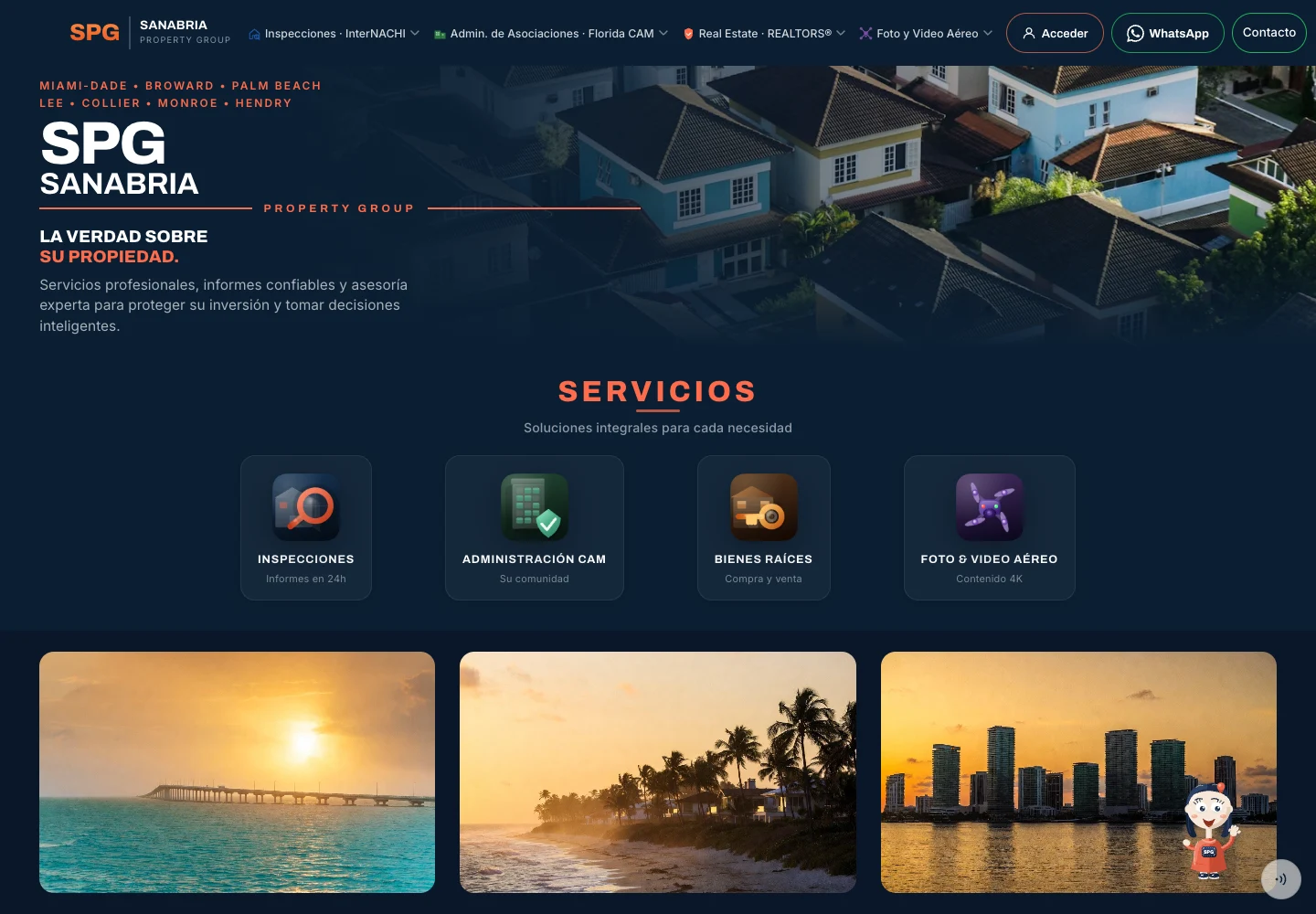
Sanabria Property Group is Daniel Sanabria's professional practice in South Florida real estate: home inspection, community association management and property services. It operates across Miami-Dade, Broward, Palm Beach, Lee, Collier, Monroe and Hendry.
The problem the site solves is not one of image. It is trust, and filtering. An owner looking for an inspector does not want a brochure: they want to know what will be delivered, how long it takes, and with what credentials. The business, in turn, needs whoever writes in to arrive already knowing which service they are asking for, because handling misdirected enquiries costs hours.
That is why the site is organised by service rather than by corporate section. Each of the four — inspections, CAM management, real estate, and aerial photo and video — has its own entry, its own explanation and its own way to make contact. The page does not try to keep you browsing: it tries to get you to the right form as fast as possible.
It is also the more complex of the two inside. Four separate forms, an access area, its own navigation and a market section. None of that comes from a plugin: it is written and versioned by hand.
sanabriapropertygroup.comTechnical sheet
- Hosting
- Cloudflare, with heavy media served from its own subdomain so it does not compete with page load.
- Build
- No CMS and no framework. The page declares no generator and loads no interface library: no React, no Vue, no jQuery.
- JavaScript
- Nine hand-written files, each with one concrete responsibility: navigation, access, the forms, the market section, the service icons. All versioned, so a change reaches the visitor without waiting for a cache to expire.
- Content
- Four active forms, twelve images served as jpg, webp, png or svg depending on what suits each one, and Inter, Archivo and Fraunces as typefaces.
- Structured data
- Declares RealEstateAgent and LocalBusiness, which is what a local real-estate professional actually is. That helps a search engine understand the entity, without promising rich results.
Why it is built this way
A home inspector competes in local searches that are both specific and crowded. Speed and clarity matter there. Every script you do not load is time you are not making somebody wait while they compare three companies on a phone.
Splitting the JavaScript into small pieces is not a whim: it lets you change a form's behaviour without touching navigation, and fix navigation without risking the access area. In a single-block site, any change forces you to review everything.
And the structured data states only what can be demonstrated. No invented ratings, no fabricated reviews, which is exactly what the structured-data policies penalise.

Designed and developed by Daniel Sanabria
USA Luxury Cleaning
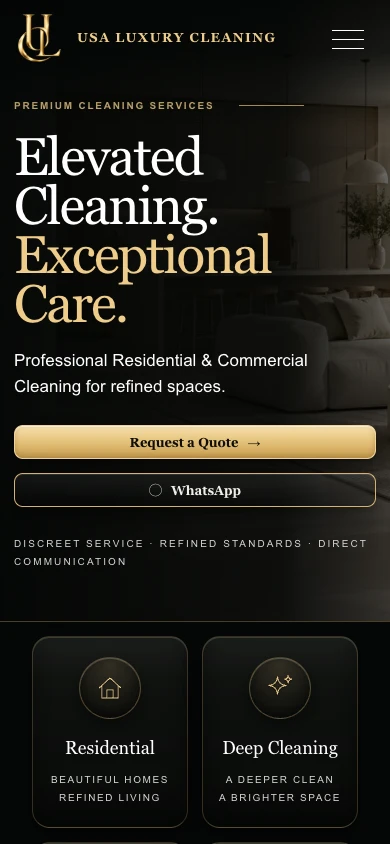
USA Luxury Cleaning is a high-end residential and commercial cleaning service. The website was designed and developed by Daniel Sanabria.
The problem here is different. In high-end cleaning, the price is not justified with a task list: it is justified by the feeling that the home is in good hands. The page has to convey care before it explains anything, because whoever hires this service is letting somebody into their house.
So the homepage opens with photography of real spaces and a serif typeface, which is the opposite of what the rest of the sector does. The four services — residential, deep cleaning, move-in and move-out, and commercial — appear as equal pieces, with no sales hierarchy, because the client already knows which one they need when they arrive.
It is a bilingual site. English and Spanish coexist in the structure itself, not as a translation pasted on top, because South Florida works that way.
usaluxurycleaning.comTechnical sheet
- Hosting
- Railway, served from its own domain with no intermediaries and no third-party caching layers.
- Build
- No CMS and no framework, same as the previous one. No generator declared, no interface library loaded.
- JavaScript
- A single hand-written file. All of the site's behaviour fits there, because the page needs no more than what it does.
- Content
- Twelve images in png and webp with lazy loading, and two embedded videos. Images that are not visible yet are not downloaded.
- Bilingual
- English and Spanish with declared links between versions, so a search engine knows they are the same page in two languages and not duplicate content.
- Structured data
- Declares Organization and WebSite, which is what a service company with its own presence actually is.
Why it is built this way
A single JavaScript file is not laziness, it is proportion. The page needs a menu, a language switch and little else. Loading a three-hundred-kilobyte library for that would be paying a toll and getting nothing back.
Video and photography are heavy, and in a sector where the image is the argument they cannot be sacrificed. The compensation comes from the other side: modern formats, lazy loading and zero surplus code. The weight budget gets spent where it contributes.
The bilingual setup is declared in the structure, not solved with a translator layered on top. An automatic translator produces pages a search engine does not know whether to index. Two versions declared as equivalents, it does.
You are looking at it
This very page
The third proof is the one you are looking at. DSEO Marketing was built under the same rule as the other two: no visual builders, no purchased templates, no third-party themes.
It is made with Astro, which is a build tool and not a browser library: the framework works on your machine at compile time and never travels to the visitor. What reaches the browser is static HTML, stylesheets and a few files of our own JavaScript.
If you want to check, you do not have to take my word for it: view the source of this page and add it up. One warning almost nobody gives: the browser network tab does not list inlined modules, so it will show you less than is actually delivered.
Technical sheet
- JavaScript
- Between 5.8 and 8.9 kilobytes depending on the page, counting both external files and the modules inlined in the HTML. The high figure is the homepage, which carries the animated field; the rest stay under six.
- Interface libraries
- None. No React, no Vue, no jQuery, no Alpine, no htmx loaded in the browser.
- Generator
- The page declares none, because no third-party product generates it.
- Typefaces
- Bundled with the site, not requested from somebody else's server on every visit.
- Accessibility and responsive
- Checked automatically on every change, across sixteen combinations of language and screen width, from 320 to 1440 pixels.
Why it is built this way
Because preaching is easier than proving. An agency that sells speed and then serves its own site with two megabytes of scripts is saying two things at once, and only one of them is true.
Under nine kilobytes is not a number to boast about. It is the consequence of not loading anything that is not needed. The same criterion we apply when the site is yours.
Want one built the same way?
No template, no builder, no plugin you will have to keep paying for. Tell us what the business needs and we will tell you what it actually takes.